
Commercial Grade Grills for Foodservice Operations: 2026 Guide

Commercial grade grills are heavy-duty cooking appliances built to deliver consistent heat output, precise temperature control, and high-volume throughput in professional foodservice environments. Unlike residential units, these grills meet the demands of restaurant kitchens, catering operations, and quick-service environments where speed, food safety, and labor efficiency are non-negotiable. The right grill choice directly affects ticket times, food quality, and operating costs. This guide covers the major grill types, the features that matter most, and how to match equipment to your specific operation.
1. What are commercial grade grills for foodservice operations?
Commercial grade grills are defined by their construction standards, output capacity, and operational durability. They use heavy-gauge metals, high-BTU burners, and controls designed for continuous daily use across multiple service periods. The term “commercial grade” is the industry’s shorthand for equipment that meets NSF International certification standards, which govern sanitation, materials, and design for professional food preparation environments. Operators should look for NSF-listed equipment as a baseline requirement, not an optional feature.
These grills differ from consumer models in every measurable way. Burner output, cooking surface area, material thickness, and control precision all exceed what residential equipment offers. A commercial kitchen grill must perform reliably during a Friday dinner rush just as well as it does on a slow Tuesday lunch.
2. Two-sided grills: speed and consistency at scale
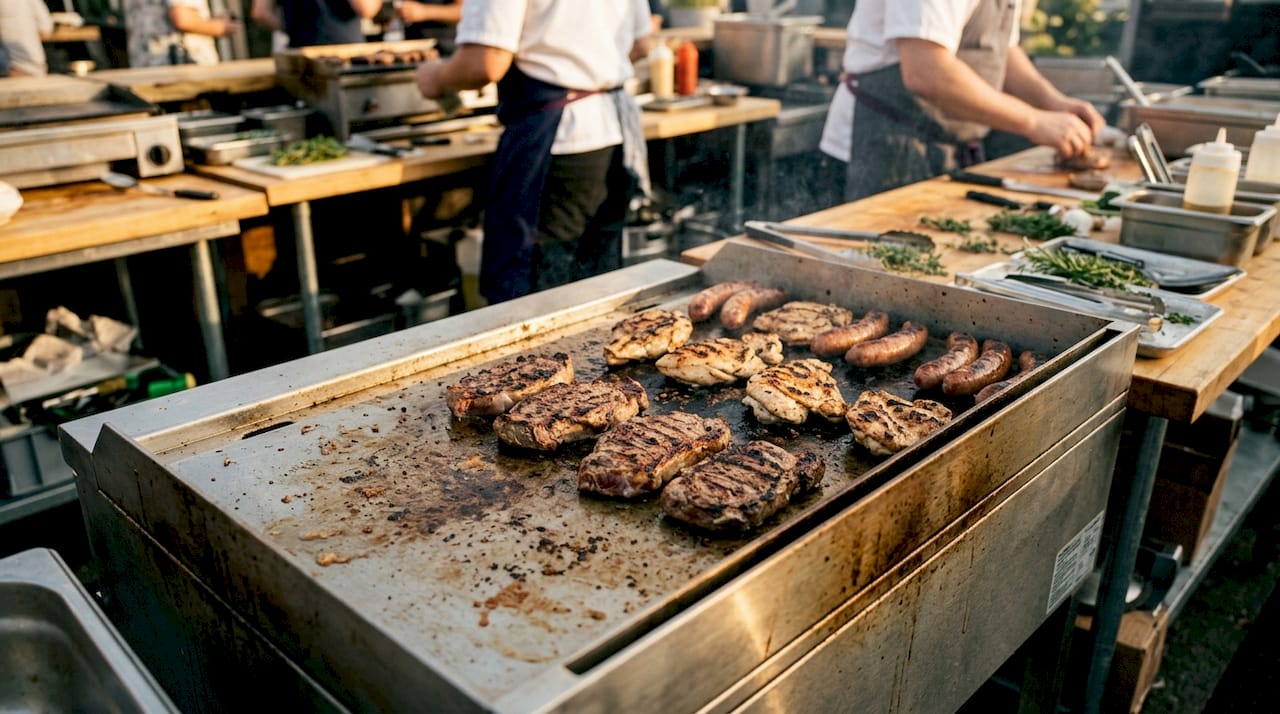
Two-sided grills cook faster and more evenly than single-surface units because heat applies from both directions simultaneously. That dual-contact method cuts cook times significantly and produces uniform results across every item on the grill. For high-volume quick-service restaurants, this is the most productive grill format available.
The best models in this category include programmable controls, automatic gapping, and dual heat zones. Automatic gapping adjusts the upper platen to match the thickness of each product, which removes the guesswork from cook cycles. Programmable controls let operators store precise time, temperature, and gap settings for every menu item.
Pro Tip: Store separate cook programs for breakfast, lunch, and dinner menus. Switching between service periods takes seconds instead of requiring staff to recalibrate manually.
3. Gas-powered grills: output and heat control
Gas-powered commercial grills deliver high BTU output with precise heat control, making them the most common choice in full-service restaurant kitchens. Gas responds immediately to temperature adjustments, which gives cooks direct control over searing, finishing, and holding temperatures. That responsiveness is critical in kitchens where menu items require different heat levels in rapid succession.
Weighted platen options on gas two-sided units add consistent pressure across the cooking surface. This improves contact, reduces cook time, and produces better sear marks without manual pressing. Gas grills also tend to have lower operating costs per hour than electric units in most U.S. markets where natural gas rates are favorable.
4. Electric grills: consistency and energy precision
Electric commercial grills excel at temperature consistency. They hold set temperatures more steadily than gas units because they do not fluctuate with gas pressure or ambient conditions. This makes them the preferred choice for operations that require exact, repeatable results, such as hotel banquet kitchens or commissary operations producing standardized menu items.
Energy consumption is the main trade-off. Electric grills draw significant amperage and require dedicated electrical circuits, which adds to installation costs. However, in locations where electricity rates are low or gas infrastructure is unavailable, electric units are the practical solution. They also produce no combustion byproducts, which simplifies ventilation requirements in some jurisdictions.
5. Charbroilers: flavor and high-heat performance
Charbroilers use radiant heat from gas burners below a grate to produce the char marks and smoky flavor that define grilled steaks, chicken, and seafood. They are standard equipment in steakhouses, casual dining chains, and any operation where grilled flavor is a menu differentiator. Charbroilers come in both gas and electric configurations, with gas being far more common in commercial settings.
The cooking surface on a charbroiler requires more active management than a flat-top griddle. Fat drips onto the burners or radiants, creating flare-ups that add flavor but also require attention. Operators running charbroilers need staff trained in heat zone management and regular cleaning protocols to prevent grease buildup.
6. Flat-top griddles: versatility across menu categories
Flat-top griddles are the workhorses of commercial kitchens that serve diverse menus. A single griddle surface can handle eggs, pancakes, burgers, sandwiches, and vegetables simultaneously. Independent cooking zones with separate burner controls let operators run different temperatures across the same surface, which is critical for multi-item production during peak service.
The Le Griddle Grand Texan, for example, uses 304 stainless steel construction across its cooking surface and frame. That material grade resists corrosion, withstands thermal cycling, and meets commercial sanitation standards. Durable materials directly extend equipment lifespan and reduce long-term replacement costs.
Pro Tip: Zone your griddle surface by temperature at the start of each service. Assign the hottest zone to proteins, a medium zone to vegetables, and a low zone for holding. This prevents cross-contamination of heat levels and keeps ticket times consistent.
7. Infrared and specialty burner technology
Infrared burner technology improves energy efficiency and cooking consistency in commercial gas griddles by transferring heat more directly to the cooking surface. Vulcan’s IRX™ burners, for instance, reduce gas consumption while increasing heat transfer speed. Lower fuel use per service period adds up to meaningful cost savings across a full year of operation.
Infrared units also reduce cold spots on the cooking surface, which is a common problem with conventional burner designs. More even heat distribution means fewer product inconsistencies and less waste from undercooked or overcooked items. For operators running tight food cost margins, that consistency has direct financial value.
8. Programmable controls and automation
Programmable cook cycles reduce training time and labor costs by automating time, temperature, and gap control during service. A new cook can produce a correctly cooked burger on the first attempt because the grill manages the variables. This is not a convenience feature. It is a food safety and consistency tool.
Automation reduces human error in commercial kitchens, which directly supports food safety compliance. Microprocessor controls log cook cycles, flag deviations, and maintain consistent results across shifts and staff changes. For multi-unit operators, programmable grills make it possible to standardize food quality across every location without relying on individual cook skill.
9. Outdoor catering grills: portability meets volume
Commercial grills for outdoor catering combine portability with high-volume cooking capacity to meet the demands of event service. These units prioritize fast setup, stable cooking performance in variable conditions, and the ability to cook multiple items at once. A catering operation that cannot maintain output during a 500-person event loses both revenue and reputation.
Key features to look for in outdoor catering grills include foldable or removable legs, propane compatibility, and large cooking surface areas. Propane eliminates the need for gas line connections, which makes deployment flexible. Operators running outdoor events should also factor in wind protection for burners and surface temperature recovery time after loading cold product.
10. Selecting the right grill for your operation
The right grill depends on your menu, volume, and service format. Here is a direct breakdown by operation type:
- Quick-service restaurants: Two-sided programmable grills deliver the fastest cook times and the most consistent results for high-volume burger, chicken, and sandwich production.
- Fine dining kitchens: Charbroilers and high-output gas griddles give line cooks the heat control and flavor profile that upscale menus require.
- Catering and events: Portable propane flat-tops and outdoor-rated griddles handle large-scale cooking efficiently without fixed infrastructure.
- Hotel and commissary kitchens: Electric griddles with precise temperature controls produce standardized results across large batches.
- Specialty cuisine operations: Wood-fired and pellet grills add authentic smoke flavor that gas and electric units cannot replicate, making them the right choice for barbecue-focused or wood-fired concepts.
Budget is always a factor, but the lowest purchase price rarely produces the lowest total cost. A grill that requires more labor to operate, cleans poorly, or breaks down under daily use costs more over three years than a higher-priced unit that performs reliably.
Comparing commercial grill options by key features
| Grill Type | Heat Source | Automation Level | Cleaning Demand | Best Use Case |
|---|---|---|---|---|
| Two-sided contact grill | Gas or electric | High (programmable) | Low to moderate | QSR, high-volume production |
| Flat-top griddle | Gas or electric | Low to moderate | Moderate | Multi-item menus, diners |
| Charbroiler | Gas (primarily) | Low | High | Steakhouses, casual dining |
| Infrared griddle | Gas | Moderate | Moderate | Energy-focused operations |
| Outdoor catering grill | Propane | Low | Low to moderate | Events, catering |
| Electric griddle | Electric | Moderate to high | Moderate | Commissary, hotel kitchens |
Key Takeaways
The most effective commercial grill for any foodservice operation is the one that matches heat source, automation level, and cooking surface to your specific menu volume and service format.
| Point | Details |
|---|---|
| Match grill type to volume | Two-sided programmable grills lead in QSR speed; charbroilers suit flavor-driven menus. |
| Prioritize programmable controls | Automated cook cycles cut training time and reduce food safety errors across shifts. |
| Choose durable materials | 304 or 316 stainless steel construction extends lifespan and meets sanitation standards. |
| Factor in total operating cost | Fuel efficiency, labor demands, and cleaning time affect real cost more than purchase price. |
| Plan for your service format | Outdoor and catering operations need propane-compatible, portable units with fast setup. |
What I’ve learned from watching operators choose the wrong grill
The most common mistake I see operators make is buying a grill based on price per square foot of cooking surface. That metric sounds logical, but it ignores the variables that actually drive kitchen performance: automation level, heat recovery speed, and cleaning time per shift.
A charbroiler looks like a bargain until you calculate the labor cost of cleaning it twice a day in a high-volume operation. A basic flat-top griddle seems versatile until your line cooks are manually adjusting temperatures every five minutes during a dinner rush. The hidden cost of inefficient grills extends well beyond fuel. It shows up in labor hours, inconsistent food quality, and staff frustration.
Programmable two-sided grills changed how I think about kitchen efficiency. When a grill manages its own cook cycle, your staff focuses on throughput and plating instead of monitoring temperatures. That shift in attention produces faster tickets and fewer errors. For any operator running more than 200 covers per service, the labor savings from automation justify the equipment investment within the first year.
My honest recommendation: spend 30 minutes mapping your peak-hour production before you buy anything. Count how many items hit the grill simultaneously, identify your slowest cook item, and calculate how many grill minutes you need per service. That data tells you exactly what cooking surface area and automation level you need. Guessing costs more than the research.
— John
Culinaryprofis carries professional grills for every foodservice format
Culinaryprofis stocks a full range of commercial kitchen grills built for professional foodservice operations, from high-output flat-top griddles to programmable two-sided contact grills. Every product in the catalog meets commercial-grade construction standards, and the team provides direct support to help operators match equipment to their specific menu and volume requirements.
Whether you run a quick-service kitchen, a catering business, or a full-service restaurant, Culinaryprofis offers equipment options with free shipping and a flexible return policy. Call the team directly for expert guidance on selecting the right grill for your operation.
FAQ
What are commercial grade grills?
Commercial grade grills are heavy-duty cooking appliances built for continuous professional use, meeting NSF International standards for materials, sanitation, and performance in foodservice environments.
What is the best commercial grill for a high-volume restaurant?
Two-sided programmable grills deliver the fastest cook times and most consistent results for high-volume operations, automating time, temperature, and gap control to reduce labor demands.
How do programmable controls improve foodservice efficiency?
Programmable cook cycles automate time, temperature, and gap settings, which reduces training time, minimizes human error, and maintains consistent food quality across all shifts and staff changes.
What materials should a commercial grill be made from?
Quality commercial grills use heavy-gauge 304 or 316 stainless steel, which resists corrosion, withstands daily thermal cycling, and meets commercial sanitation standards for long-term durability.
Are commercial grills suitable for outdoor catering?
Yes. Commercial grills designed for outdoor catering use propane fuel and portable frames to deliver high-volume cooking capacity without fixed gas line infrastructure, making them practical for events and off-site service.