
Food Safety Equipment Restaurants Must Have in 2026

Food safety equipment in restaurants refers to the specialized tools and systems designed to prevent contamination, control food temperatures, and maintain hygienic conditions required by health regulations. The FDA Food Code and HACCP (Hazard Analysis and Critical Control Points) framework define the baseline for every commercial kitchen. NSF certification is the most important filter when selecting any food-contact equipment, as health departments and insurance providers routinely require it. Getting this right is not optional. A single failed inspection can close your doors.
Restaurant owners who treat food safety equipment as a checklist item rather than a system consistently face repeat violations. The food safety equipment restaurants must have falls into four core categories: hygiene stations, temperature monitoring tools, sanitation supplies, and food storage units. Each category maps directly to a critical control point in HACCP. Miss one, and your entire compliance structure has a gap.
1. Dedicated handwashing stations
Handwashing stations are the first line of defense against cross-contamination in any commercial kitchen. The FDA Food Code requires dedicated sinks that deliver warm running water at a minimum of 100°F (38°C). These sinks must be located in or near all food preparation areas and kept completely separate from dish and food prep sinks.
Every handwashing station must be stocked with:
- Liquid soap in a wall-mounted dispenser
- Single-use paper towels or a hands-free dryer
- A covered waste container within arm’s reach
- Posted handwashing instruction signage
Restroom handwashing stations require the same supplies and must be checked and restocked at the start of every shift. Frequency matters as much as equipment. A station that runs out of soap at 11:00 AM on a Saturday is a liability.
Pro Tip: Place handwashing sinks at every entry point to the kitchen, not just near prep tables. Staff who must walk across the kitchen to wash hands often skip it entirely.
2. Calibrated food thermometers
Accurate temperature monitoring is the backbone of HACCP compliance. Food thermometers must be accurate to ±2°F (±1°C), while ambient air thermometers in holding units must meet a ±3°F (±1.5°C) standard. Spot checks should occur every two hours during active service.
The three thermometer types every restaurant kitchen needs are:
- Digital probe thermometers for checking internal food temperatures quickly
- Infrared sensors for non-contact surface temperature readings
- Analog backup units mounted inside every refrigerator and holding cabinet
“Multiple calibrated thermometers, including secondary analog units and digital thermocouples, provide redundancy that reduces compliance risks during food storage and service. Relying on a single device creates a single point of failure that no health inspector will overlook.”
Thermometers must be calibrated regularly using the ice-water method (32°F) or boiling-water method (212°F at sea level). Keep a calibration log. An uncalibrated thermometer is legally the same as no thermometer during an inspection.
3. Digital temperature data loggers
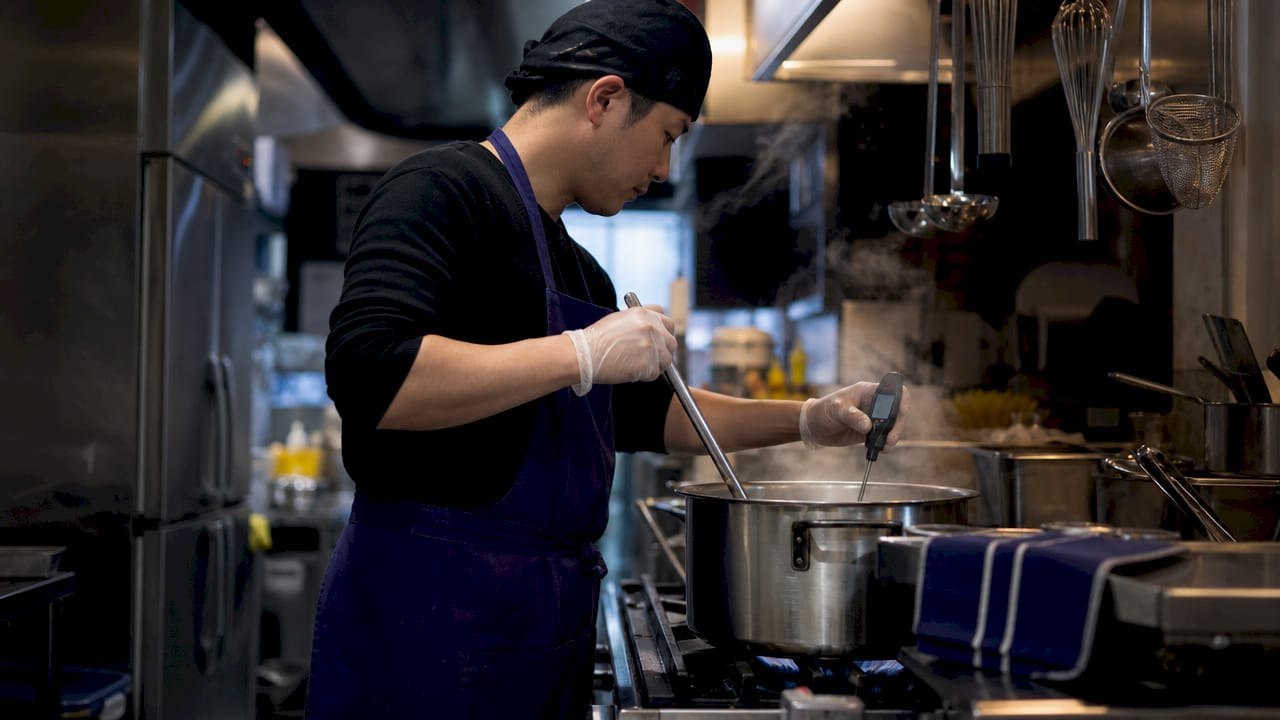
Manual temperature logs are the most commonly falsified record in commercial kitchens, a practice known as “pencil-whipping.” Digital logging systems provide 24/7 tamper-proof audit trails that make temperature and safety monitoring far more reliable than paper records.
A data logger connects to your refrigeration units, walk-in coolers, and hot holding equipment. It records temperatures at set intervals and flags any deviation automatically. During a health inspection, you pull up a clean digital record instead of a binder full of handwritten sheets. That shift alone reduces inspection anxiety significantly.
Modern wireless loggers also send alerts to your phone when a unit drifts out of range. That means a failing compressor at 2:00 AM triggers a notification before you lose an entire walk-in of product.
4. Three-compartment sink or NSF-certified dishwasher
Every restaurant must have either a three-compartment sink or an NSF/ANSI 3-certified commercial dishwasher for washing, rinsing, and sanitizing food-contact surfaces. The three-compartment setup follows a fixed sequence: wash in the first compartment, rinse in the second, and sanitize in the third. Skipping or combining steps is a direct health code violation.
Required tools for this station include:
- Commercial dish soap rated for food-contact surfaces
- NSF-approved sanitizer at the correct concentration
- Chemical test strips to verify sanitizer strength
- Dish racks, drain strainers, and specialized brushes for different surface types
Sanitizer concentrations must be checked with test strips regularly and replaced when out of specification or visibly dirty. Chlorine-based sanitizers typically require 50–100 ppm; quaternary ammonium compounds require 200–400 ppm. Know your product’s spec sheet and post it at the sink.
Pro Tip: Label each compartment with a laminated sign showing the correct chemical concentration and water temperature. New staff will follow the posted instructions far more consistently than verbal training alone.
5. NSF-certified refrigeration and freezer units
Refrigeration is where most foodborne illness outbreaks begin. NSF/ANSI 7 certification is the required standard for commercial refrigeration units used in food service. Units without this certification do not meet health code in most jurisdictions.
Every refrigerator and freezer must maintain consistent temperatures without manual intervention. Reach-in units, walk-in coolers, and under-counter refrigerators all need built-in thermometers visible from outside the unit. Do not rely on the unit’s internal digital display alone. Mount a secondary analog thermometer inside as a backup.
For catering operations and off-site food service, the same standards apply. Reviewing catering food safety practices before any off-premise event confirms your cold chain stays intact from kitchen to service point.
6. Hot holding equipment
Hot holding units keep cooked food at or above 135°F (57°C) until service. Dropping below that threshold puts food in the temperature danger zone (41°F–135°F), where bacterial growth accelerates rapidly. Steam tables, heat lamps, and warming drawers all qualify as hot holding equipment when they maintain the required temperature consistently.
Check hot holding temperatures every two hours during service. Document every reading. If a unit cannot hold 135°F, pull the food and either reheat it to 165°F or discard it. There is no middle ground on this standard.
7. Food storage containers with date labels
Proper food storage safety containers prevent cross-contamination and spoilage. The FDA Food Code mandates that raw animal foods be stored below ready-to-eat foods at all times. That means raw poultry on the bottom shelf, raw beef above it, raw pork above that, and ready-to-eat items on top.
Every container must carry a label showing the product name and the date it was prepared or opened. Most health codes require a discard date no more than seven days from preparation for refrigerated items. Use color-coded day-dot labels to make this system fast and foolproof for all staff.
8. Adequate kitchen lighting
Lighting is a food safety tool, not just a comfort feature. The FDA Food Code mandates a minimum of 50 foot-candles at surfaces where food is actively processed or examined. General food preparation areas require at least 20 foot-candles. Insufficient lighting leads to missed contamination, improper cuts, and undetected equipment damage.
Inspect lighting fixtures regularly. Burned-out bulbs above prep surfaces are a direct health code violation in most states. Shatter-resistant bulb covers are required over any open food area.
9. Personal protective equipment and hygiene supplies
Gloves, hairnets, and aprons are classified as kitchen hygiene products under most state health codes. Single-use gloves must be changed between tasks, especially when switching from raw proteins to ready-to-eat foods. Gloves are not a substitute for handwashing. They are an additional barrier, used after washing.
Stock disposable gloves in multiple sizes. A glove that does not fit correctly tears easily and provides false confidence. Keep hairnets and beard covers at every kitchen entry point so staff put them on before entering, not after.
10. Pest control and waste management equipment
Covered waste containers, floor drains with grates, and sealed storage bins are all restaurant health compliance gear that directly affects pest control. Open waste containers attract insects and rodents, which are among the fastest routes to a failed inspection. Every trash receptacle in a food prep or storage area must have a tight-fitting lid.
Floor drains must be cleaned and sanitized daily. Grease buildup in drains is a common source of fruit fly infestations that can shut down a kitchen within days of appearing.
11. Staff training documentation and signage
Equipment alone does not prevent foodborne illness. A food safety checklist with accountability-driven verification is required. Tools without enforced pre-shift inspections and corrective actions fail consistently. Laminated handwashing signs, allergen charts, and temperature logs posted at each station serve as constant reminders and training reinforcement.
Document all staff training in food safety with signed records. Health inspectors ask for these records. A kitchen with perfect equipment but no training documentation will still receive violations.
Key Takeaways
The food safety equipment restaurants must have forms a complete system: hygiene stations, calibrated thermometers, NSF-certified storage, and documented sanitation protocols working together prevent violations and protect guests.
| Point | Details |
|---|---|
| Handwashing stations | Provide 100°F water, soap, paper towels, and signage at every prep area entry. |
| Thermometer accuracy | Use digital probes (±2°F) and analog backups; log temperatures every two hours. |
| NSF certification | Require NSF/ANSI certification on all refrigeration, dishwashers, and food-contact surfaces. |
| Digital logging | Replace manual paper logs with tamper-proof digital systems for audit-ready records. |
| Storage organization | Store raw animal foods below ready-to-eat items and label every container with a discard date. |
Why physical equipment is only half the compliance equation
I have walked through dozens of commercial kitchens that had every piece of equipment on the checklist. Calibrated thermometers, three-compartment sinks, NSF-certified reach-ins. And they still failed inspections. Every time, the reason was the same: no documentation.
The biggest compliance gap I see is the assumption that having the right equipment means you are compliant. It does not. Temperature records and cleaning logs represent the biggest compliance hurdle for most operators. A fully operational kitchen with no paper trail looks exactly like a negligent one to an inspector.
My recommendation is to start with the physical equipment, get it certified and installed correctly, and then immediately build the documentation system around it. Digital loggers are worth every dollar because they remove the human temptation to fill in a log retroactively. Once your records are automated, inspections become straightforward. You stop dreading them.
The restaurants I have seen pass inspections consistently are not the ones with the newest equipment. They are the ones where every staff member knows the protocol and every reading gets recorded. That combination is what separates a compliant kitchen from a lucky one.
— John
Culinaryprofis has the commercial kitchen equipment you need
Restaurant owners who need reliable, commercial-grade food safety equipment have a direct resource in Culinaryprofis. The site carries refrigeration units, food prep tools, and commercial kitchen appliances built to NSF and FDA Food Code standards.
Culinaryprofis also publishes practical guides, including a restaurant kitchen equipment checklist and HACCP compliance resources, to help you plan purchases and stay current with health code requirements. Browse the full catalog at culinaryprofis.com to find equipment that meets your compliance needs and holds up under daily commercial use.
FAQ
What food safety equipment do restaurants legally need?
Restaurants must have dedicated handwashing sinks, calibrated thermometers, NSF-certified refrigeration, a three-compartment sink or certified dishwasher, and hot holding equipment that maintains 135°F or above. Specific requirements vary by state, but the FDA Food Code sets the national baseline.
How often should restaurant thermometers be calibrated?
Thermometers should be calibrated at the start of each shift and any time they are dropped or exposed to extreme temperatures. The ice-water method (32°F) is the standard field calibration technique.
What is NSF certification and why does it matter?
NSF certification confirms that equipment meets sanitation and material safety standards required by health departments. Health inspectors and insurance providers routinely require NSF certification on all food-contact surfaces and refrigeration units.
Can digital loggers replace manual temperature logs?
Digital logging systems provide tamper-proof, continuous records that satisfy health code documentation requirements and are accepted by inspectors as a replacement for manual logs. They also send real-time alerts when temperatures drift out of safe range.
How should raw and ready-to-eat foods be stored?
Raw animal foods must be stored below ready-to-eat foods in every refrigeration unit, with raw poultry on the lowest shelf. This physical separation is a direct FDA Food Code requirement and one of the most commonly cited violations during inspections.