
What Is a Rapid Cook Oven: Pro Guide for 2026

A rapid cook oven is a commercial-grade appliance that combines microwave energy, high-velocity air impingement, and infrared heating to cook food up to 15 times faster than a conventional oven while preserving texture, moisture, and browning. The industry also calls these units “speed ovens” or “high-speed ovens,” and brands like TurboChef, Merrychef, and Pratica have built entire product lines around this technology. If you work in a professional kitchen or run a serious home setup, understanding how these ovens function gives you a real operational edge. This guide covers the technology, the tradeoffs, and exactly what to look for before you buy.
How does a rapid cook oven work?
A rapid cook oven fires three heat sources at the same time, and that simultaneous action is what separates it from every other countertop appliance. Three heat sources combined — microwave energy, high-speed air impingement, and infrared elements — work together inside a single cooking chamber operating at 500–536°F (260–280°C).
Microwave energy
Microwave energy penetrates food and heats it from the inside out. This cuts the time needed to bring the core of a protein or dense carbohydrate up to temperature. On its own, microwave heating produces the soggy, pale results every cook recognizes. That is why it is only one part of the system.
High-speed air impingement
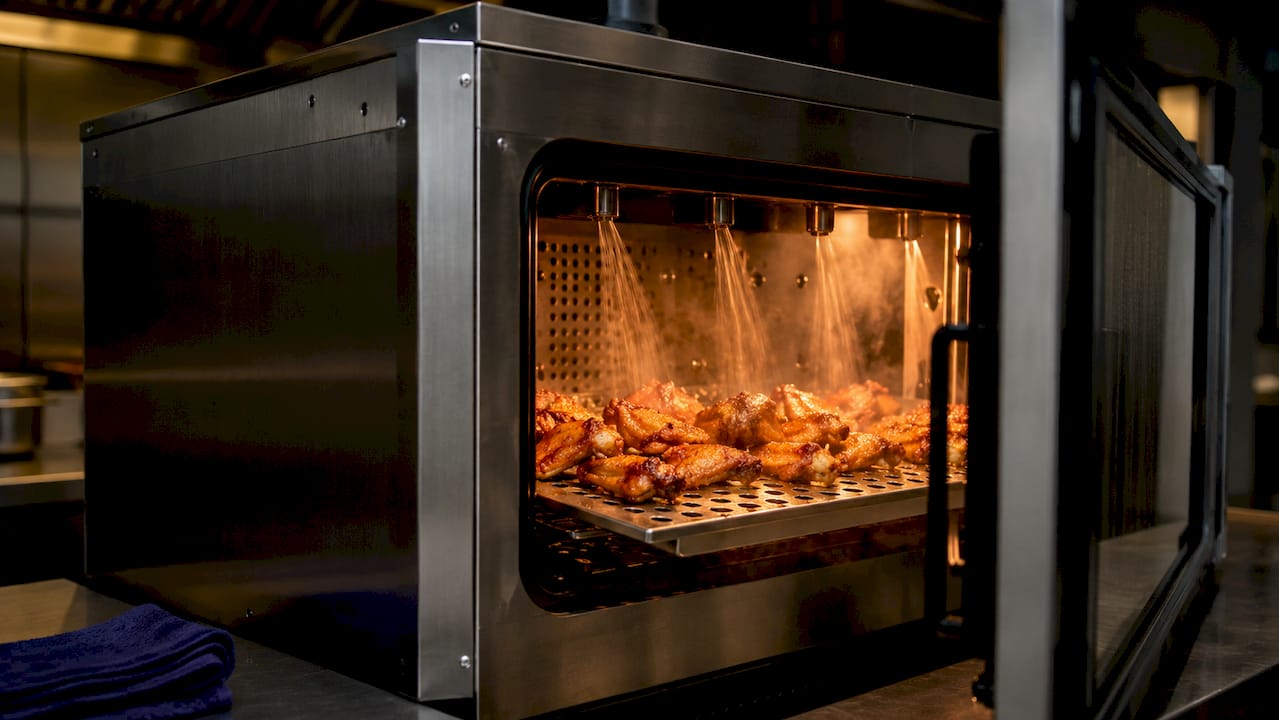
Impingement jets force superheated air directly onto the food surface at high velocity. This strips away surface moisture rapidly, which is the physical mechanism behind crisping and browning. A standard convection oven circulates air passively. Impingement targets the food surface with precision, which is why a rapid cook oven can produce a crispy pizza crust or a golden panini in under two minutes.
Infrared heating
Infrared elements handle searing and finishing. They deliver radiant heat that caramelizes sugars and melts cheese without overcooking the interior. Impingement and infrared heat actively evaporate surface moisture and create crisp textures, which directly counters the common misconception that these are just fancy microwaves.
- Microwave energy: internal heating, reduces core cook time
- Air impingement: surface crisping and browning via high-velocity hot air
- Infrared: searing, caramelizing, and finishing
- Combined effect: golden crusts with moist interiors in a fraction of conventional cook time
Pro Tip: Never block the impingement vents inside the cooking cavity. Even partial obstruction from oversized cookware reduces airflow and kills the crisping effect that makes these ovens worth the investment.
What are the benefits and limitations of rapid cook ovens?
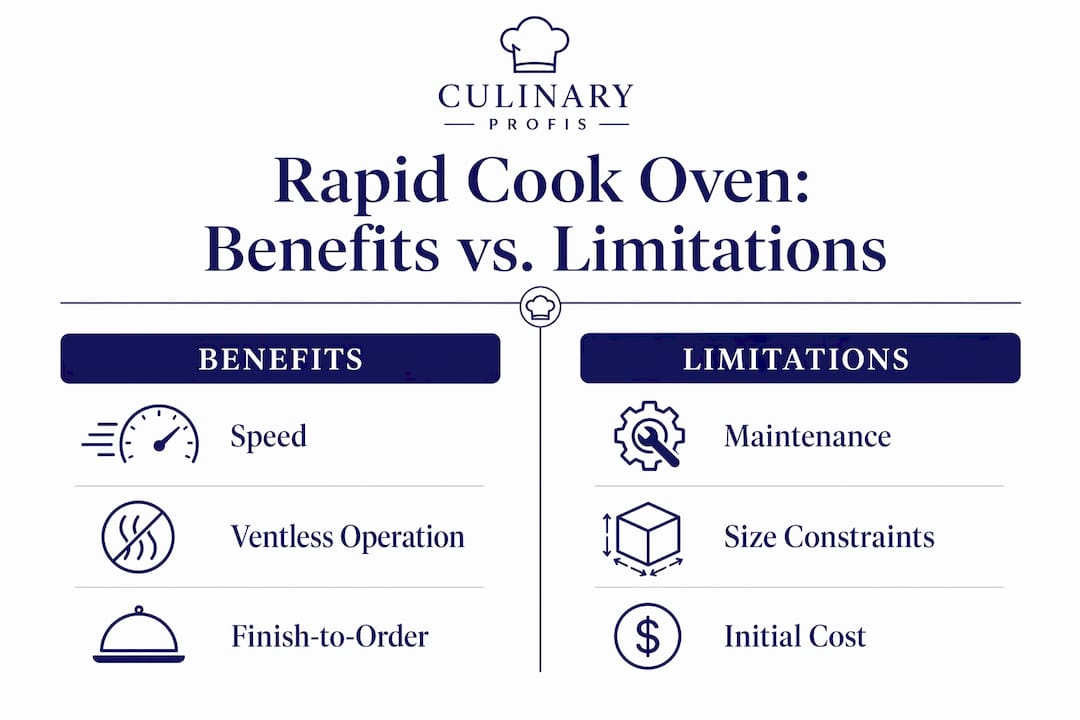
The speed advantage is the headline number, but the operational implications go deeper than that. Non-microwave models cook up to 5 times faster than conventional ovens, while models with microwave energy reach 10–15 times faster. That means a dish that takes 20 minutes in a deck oven finishes in 90 seconds to 4 minutes in a speed oven. At peak service, that difference is the gap between a smooth ticket flow and a backed-up pass.
Real-world advantages
The benefits extend well beyond raw speed. Ventless operation is one of the most practical. Most commercial countertop units require only a single-phase 208/240V power supply and occupy roughly 2 square feet of counter space. No external exhaust hood is needed because internal catalytic converters clean grease and smoke. That single feature opens up installation locations that would otherwise require expensive ventilation buildouts.
Finish-to-order service is another structural benefit. Instead of batch cooking and holding food in warmers, a kitchen can cook each item fresh when the order arrives. This reduces food waste and delivers a noticeably better product to the customer. Cafes, hotel grab-and-go stations, and quick-service operations have adopted this model specifically because speed ovens make it viable.
Pre-programmed settings deliver consistent results across staff skill levels. A line cook and a new hire produce the same output because the oven controls the variables. This is a significant advantage in high-turnover kitchen environments.
Limitations to know before you buy
- Cavity size. The small cooking chamber limits batch volume. These ovens are built for finish-to-order, not high-volume batch production. If you need to cook 40 portions simultaneously, a combi oven or deck oven is the right tool.
- Weight. Units weigh around 200 pounds despite their compact footprint. Installation requires planning and proper support.
- Maintenance. Catalytic converters require periodic cleaning to maintain health and safety compliance. Skipping this step can cause inspection failures.
- High-voltage components. Internal systems operate at high voltage. All maintenance beyond cleaning must be performed by trained technicians.
Pro Tip: Schedule catalytic converter cleaning on a fixed calendar interval, not when performance drops. Waiting until you notice smoke or odor means you are already out of compliance.
Rapid cook oven vs microwave vs conventional oven
The comparison matters because each technology has a defined role, and buying the wrong one for your workflow is an expensive mistake. The table below lays out the key differences across the metrics that matter most to professional and serious home kitchens.
| Feature | Rapid cook oven | Microwave only | Conventional oven |
|---|---|---|---|
| Cook speed | 10–15x faster than conventional | 5–8x faster than conventional | Baseline |
| Food texture | Crispy exterior, moist interior | Soft, often soggy exterior | Good browning with longer time |
| Browning capability | Yes, via impingement and infrared | No | Yes, via radiant heat |
| Ventless operation | Yes, with catalytic converter | Yes | No (requires ventilation) |
| Counter footprint | ~2 square feet | ~1–1.5 square feet | Large or built-in |
| Power requirement | 208/240V single-phase | 120V standard | 240V or gas |
| Best use case | Finish-to-order, high-speed service | Reheating, defrosting | Batch cooking, baking |
| Batch capacity | Low | Low | High |
| Maintenance complexity | Moderate (catalytic converter) | Low | Low to moderate |
The rapid cook oven wins on speed and food quality simultaneously. A microwave reheats faster but cannot brown. A conventional oven browns well but cannot compete on speed. For high-volume cooking appliances in professional settings, the speed oven fills a gap that neither alternative covers.
The energy profile also favors speed ovens in finish-to-order contexts. Because cook times are so short, total energy consumed per item is lower than running a conventional oven for the same output. The oven also reaches operating temperature faster, which reduces idle energy draw during slower service periods.
What should you look for when choosing a rapid cook oven?
Selecting the right model starts with matching the oven’s specifications to your actual workflow, not to the most impressive spec sheet number.
Key features to evaluate
Power and electrical setup come first. Confirm your kitchen has a 208/240V single-phase circuit available at the installation location. If not, factor in the cost of an electrical upgrade before comparing oven prices. For guidance on electrical setup for commercial ovens, the procurement process matters as much as the unit itself.
Programmable recipe storage is the second priority. TurboChef models like the Tornado and the Encore series store hundreds of pre-programmed cook cycles. Merrychef’s eikon series offers touchscreen controls with image-based recipe selection. Both approaches reduce training time and improve consistency. Choose based on how your team interacts with equipment under pressure.
Cavity size determines what you can actually cook. Most countertop speed ovens accommodate a 12-inch pizza or a standard half-pan. If your menu requires larger formats, look at floor-standing models or consider stacking two units.
Ventless certification matters for permitting. Confirm the unit carries NSF and UL certifications for ventless operation in your jurisdiction before purchase.
Maintenance and longevity
- Clean the catalytic converter on the manufacturer’s recommended schedule, typically every 30–90 days depending on use volume.
- Wipe down the interior cavity after each service to prevent grease buildup on impingement vents.
- Log all maintenance with dates. Health inspectors and service technicians both require this documentation.
- Schedule annual professional inspections of high-voltage components. Do not attempt internal repairs without certified technicians.
- Review the commercial oven duty cycle rating for your chosen model to confirm it matches your expected daily use volume.
Pro Tip: Buy from a supplier that offers direct access to certified service technicians. A speed oven sitting idle during a busy service because no one can get a technician on-site costs far more than the price difference between vendors.
Key takeaways
A rapid cook oven is the most efficient tool for finish-to-order cooking in professional and serious home kitchens, combining three heat sources to deliver speed and food quality that neither microwaves nor conventional ovens can match alone.
| Point | Details |
|---|---|
| Three-source technology | Microwave, impingement, and infrared work together to cook fast and produce crispy results. |
| Speed advantage | Models with microwave energy cook up to 15 times faster than conventional ovens. |
| Ventless installation | Internal catalytic converters eliminate the need for external exhaust hoods. |
| Finish-to-order workflow | Small cavity size makes these ovens ideal for per-order cooking, not batch production. |
| Maintenance is non-negotiable | Catalytic converter cleaning and professional inspections are required for safety and compliance. |
Why I think most kitchens underuse this technology
I have watched speed ovens sit in corners of professional kitchens, used only for reheating bread rolls, while the team runs a conventional oven at full capacity for tasks the speed oven would handle in 90 seconds. The problem is almost never the equipment. It is the lack of structured onboarding when the unit arrives.
The kitchens that get full value from a TurboChef or Merrychef unit are the ones that spend two hours programming their most common menu items into the oven’s recipe memory before service begins. After that, the consistency gains are immediate. A new hire produces the same output as a five-year veteran on those items. That is not a small thing in a high-turnover industry.
For serious home cooks, my honest recommendation is to treat the speed oven as a primary cooking tool, not a supplement. Pair it with a quality induction cooktop and you cover 80% of what a full commercial kitchen does, in a fraction of the space. The learning curve is short. The results are not.
The one area where I see people get burned is maintenance. These units are not plug-and-play for the long term. The catalytic converter schedule is real, and the high-voltage internals require professional hands. Budget for that service cost from day one, and the oven will perform for a decade or more.
— John
Upgrade your kitchen with Culinaryprofis
Culinaryprofis stocks commercial-grade kitchen equipment for professional chefs and serious home cooks who need reliable, high-performance tools. If you are evaluating speed ovens or planning a broader kitchen upgrade, the Culinaryprofis team provides direct expert support to match the right equipment to your workflow and space.

Browse the full selection of commercial kitchen appliances at Culinaryprofis, including ovens, ranges, refrigeration, and food prep equipment from leading brands. Free shipping, a flexible return policy, and access to knowledgeable support staff make Culinaryprofis the practical choice for buyers who need more than a product listing. Call us NOW to speak with a specialist about your rapid cook oven options.
FAQ
What is a rapid cook oven used for?
A rapid cook oven is used for finish-to-order cooking in commercial and serious home kitchens, producing crispy, evenly cooked food up to 15 times faster than a conventional oven. Common applications include pizza, sandwiches, proteins, and baked goods.
How is a rapid cook oven different from a microwave?
A rapid cook oven adds high-speed air impingement and infrared heating to microwave energy, which produces browning and crisping that a microwave alone cannot achieve. The result is food with a properly textured exterior and a fully cooked interior.
Do rapid cook ovens require special ventilation?
Most commercial countertop rapid cook ovens are ventless. They use internal catalytic converters to filter grease and smoke, eliminating the need for an external exhaust hood, though the catalytic converter requires regular cleaning to maintain compliance.
What brands make the best rapid cook ovens?
TurboChef and Merrychef are the most widely used commercial brands, with models like the TurboChef Tornado and the Merrychef eikon series offering programmable recipe storage and proven durability in high-volume service environments.
Can a rapid cook oven replace a conventional oven?
A rapid cook oven handles finish-to-order cooking better than a conventional oven, but its small cavity limits batch volume. For large-scale batch production or full baking programs, a conventional or combi oven remains the better tool.