
Why Catering Vehicle Equipment Storage Drives Efficiency

Catering vehicle equipment storage is the deliberate practice of organizing and securing catering tools, supplies, and food within mobile units to protect gear, maximize space, and maintain operational readiness. For catering professionals running events of any scale, how you store equipment inside your vehicle directly determines how fast you set up, how safely you transport food, and how long your gear lasts. A standard cargo van offers roughly 250 cubic feet of usable space. Every cubic foot counts. This guide covers why vehicle storage organization matters, which solutions work best, and how to build a system that scales with your business.
Why catering vehicle equipment storage determines operational success
Organized storage in mobile food units directly impacts workflow, inventory management, and profitability. That connection is not abstract. When a team arrives at a venue and cannot locate the bain-marie or the serving trays are buried under cleaning supplies, setup time doubles and service quality drops before the first guest arrives.
Poor weight distribution compounds the problem. Heavy items like full hot boxes, which weigh approximately 60 pounds, should be stored low and forward in the vehicle. This placement improves handling, reduces driver fatigue, and supports fuel efficiency. Stacking heavy gear high and toward the rear does the opposite on all three counts.
Storage quality also affects food safety compliance. Temperature management in storage is critical for preventing spoilage and meeting health regulations. Cold boxes and hot boxes must be stored in separate, clearly defined zones. Cross-contamination between food zones and cleaning supply areas is a regulatory violation in most jurisdictions, not just a best practice concern.
Failing to use vertical space in vehicles results in inefficient workflows and increased physical strain on personnel. A crew that bends, digs, and shuffles gear on every job accumulates fatigue faster and makes more errors during service. Vertical tiered racks solve this directly by putting every item at eye level and arm’s reach.
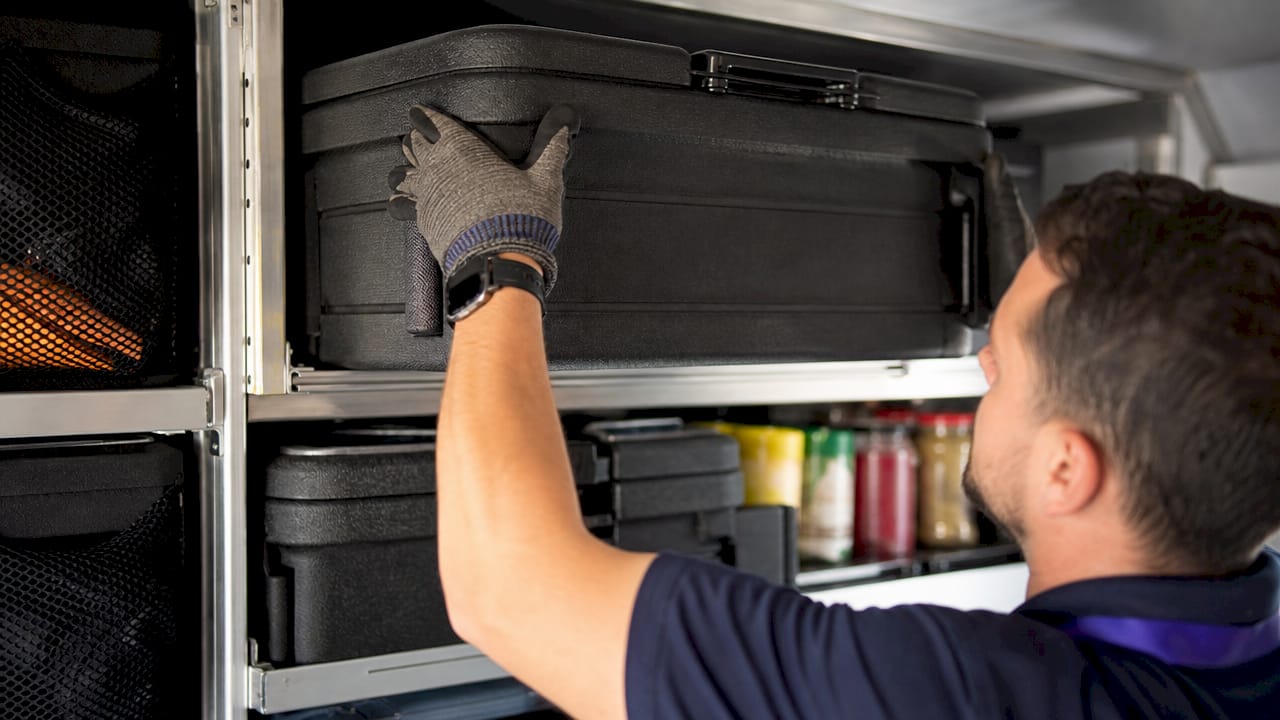
Pro Tip: Label every shelf zone with waterproof labels before your first event. A labeled system takes 30 minutes to set up and saves hours of searching across a full season.
What are the best catering equipment storage solutions for vehicles?
The right storage solution depends on your vehicle type, event volume, and the gear you carry. That said, certain categories of equipment consistently outperform improvised arrangements.
Tiered shelving and racks
Tiered shelving units are the foundation of any well-organized catering vehicle. They convert floor space into vertical storage, which is the only way to make a cargo van work at full capacity. Aluminum shelving is preferred over steel in mobile applications because it resists corrosion from food moisture and weighs less. Adjustable shelf heights let you reconfigure the layout when your menu or event type changes.
Storage bins, cargo nets, and dividers
Loose items shift during transit and arrive damaged or disorganized. Stackable polypropylene bins with lids contain smaller tools, condiments, and prep supplies without sliding. Cargo nets stretched across open shelving prevent items from falling during hard stops. Dividers inside bins separate utensils by category so the team pulls exactly what they need without sorting through a mixed pile.
Dedicated temperature zones
Separate your vehicle into clearly defined hot, cold, and dry zones. Hot boxes go in one area, insulated cold storage in another, and dry goods in a third. This separation is not just about efficiency. It is a food safety requirement. Mixing zones creates contamination risk and makes temperature monitoring unreliable.
Here is a practical comparison of storage approaches by vehicle type:
| Storage approach | Best for | Key advantage | Key limitation |
|---|---|---|---|
| Tiered aluminum shelving | Cargo vans and box trucks | Maximizes vertical space | Requires secure mounting |
| Modular bin systems | All vehicle types | Flexible and reconfigurable | Bins can shift without netting |
| Built-in cabinetry | Dedicated box trucks | Permanent and secure | Expensive and inflexible |
| Portable coolers and hot boxes | Vans and smaller vehicles | Easy to move and swap | Limited capacity per unit |
For catering professionals building out a vehicle for the first time, a catering equipment checklist helps identify exactly which items need dedicated storage zones before you buy shelving.
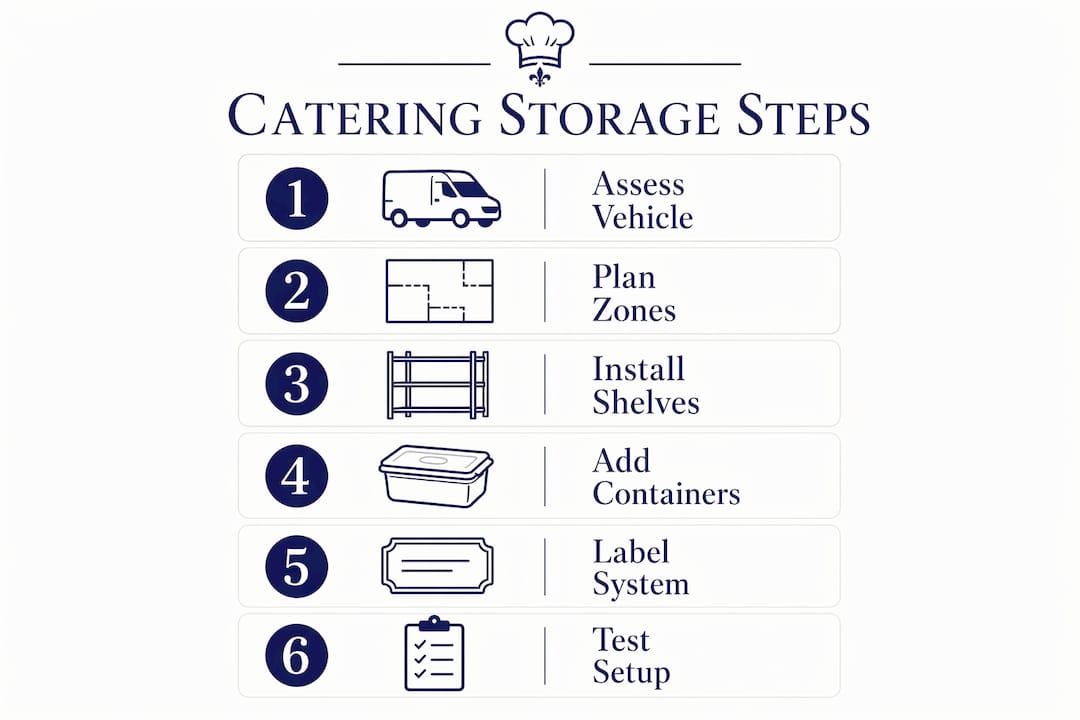
How to implement storage best practices by vehicle type and business scale
Storage strategy should match the scale of your operation. A solo operator running a cargo van for 50-person events needs a different system than a team running a box truck for 200–300 guests. Box truck configurations for larger events can represent a $45,000 to $70,000 investment. Getting the storage layout right from the start protects that investment.
-
Start with non-negotiable equipment. Industry experts recommend focusing first on core equipment essentials before expanding your inventory. For most operators, that means a griddle, bain-marie, fridge-freezer, and water boiler as the four essential pieces to prioritize. Build your storage zones around these items first, then add capacity as revenue grows.
-
Plan zones differently for cargo vans versus box trucks. A cargo van has limited headroom, so horizontal organization matters as much as vertical. A box truck offers full standing height, which means floor-to-ceiling shelving is viable. In a box truck, you can create a true walk-in workflow with a loading zone at the rear and a prep zone toward the cab.
-
Choose portable equipment over permanent built-in systems where possible. Portable equipment connected to venue mains is more cost-effective and flexible than permanent built-in cooling or heating systems. This approach also keeps your vehicle adaptable. If your event mix changes, you are not locked into a fixed configuration.
-
Plan your power infrastructure before finalizing storage. Mobile catering generators are typically sized at 4–5kVA to power refrigeration, lighting, and cooking equipment. Know your power draw before you decide which equipment gets permanent vehicle storage versus which items you plug in on-site.
-
Put quick-access items at the rear door. The items your team grabs first at every event, such as serving trays, gloves, and hand sanitizer, belong at the rear door within arm’s reach. Items used only during setup or breakdown go deeper into the vehicle.
Pro Tip: Run a timed dry-run setup in your driveway before your first event with a new storage layout. If any item takes more than 10 seconds to locate, reposition it.
For guidance on selecting gear suited to vehicle use, the Culinaryprofis guide on portable commercial cooking equipment covers power requirements and size considerations in detail.
What are common storage pitfalls and how do you avoid them?
Most storage problems in catering vehicles come from a small set of repeatable mistakes. Recognizing them early prevents equipment damage, safety violations, and lost time.
-
Overloading shelves and ignoring weight limits. Every shelving unit has a rated load capacity. Exceeding it causes shelf failure during transit, which damages equipment and creates a safety hazard. Check the manufacturer’s weight rating before loading any shelf.
-
Mixing food storage with cleaning supplies. Cleaning chemicals stored near food containers create cross-contamination risk. Health inspectors treat this as a serious violation. Assign cleaning supplies their own sealed bin in a separate zone, ideally near the vehicle door for easy access during breakdown.
-
Investing in permanent built-in units too early. Permanent cabinetry locks you into a fixed layout. If your business model shifts from corporate lunches to outdoor festivals, a built-in system may not serve the new workflow. Modular and portable solutions preserve flexibility without sacrificing organization.
-
Skipping regular inventory reviews. Clutter accumulates fast in a working vehicle. A monthly inventory check removes expired supplies, identifies damaged equipment, and confirms that storage zones are still serving their intended purpose. A cluttered vehicle is a slow vehicle.
-
Ignoring ergonomics. Items that require bending or overhead reaching on every job create injury risk over time. Position the heaviest and most frequently used items between knee and shoulder height. This single adjustment reduces physical strain across a full event season.
For large-scale event logistics and how storage integrates with the full operational picture, the corporate event catering guide from Mile High Cook covers vehicle coordination and workflow in detail.
Key takeaways
Proper catering vehicle equipment storage directly determines setup speed, food safety compliance, and equipment longevity across every event you run.
| Point | Details |
|---|---|
| Weight distribution matters | Store heavy items like full hot boxes low and forward to improve handling and fuel efficiency. |
| Vertical space is non-negotiable | Tiered shelving in a 250-cubic-foot cargo van prevents congestion and reduces physical strain. |
| Separate temperature zones | Keep hot, cold, and dry storage zones distinct to meet food safety regulations and prevent spoilage. |
| Start with core equipment | Prioritize a griddle, bain-marie, fridge-freezer, and water boiler before expanding storage capacity. |
| Portable beats permanent early on | Portable equipment connected to venue power offers more flexibility and lower cost than built-in systems. |
What I’ve learned from watching catering vehicles get it wrong
Most catering operators I have seen underestimate their vehicle interior until they are standing in a parking lot at 6 a.m., 45 minutes behind schedule, because nobody can find the chafing fuel. The vehicle interior is premium real estate. Every inch should have a job.
The counterintuitive lesson is that less equipment, stored better, outperforms more equipment stored poorly. Operators who start lean, with the four core pieces and a clean shelving system, consistently run faster setups than operators who pack every piece of gear they own into a van with no system. The gear you cannot find in 10 seconds might as well not be there.
Portable equipment also gets undervalued. Catering professionals often assume built-in systems signal professionalism. They do not. They signal inflexibility. The operators I have seen scale fastest are the ones who kept their vehicle layout modular and adapted it as their event mix evolved.
Review your storage layout after every three events. What slowed you down? What did you reach for most? What never left the vehicle? Those answers tell you exactly where to reorganize. The best storage system is not the most expensive one. It is the one your team can work without thinking.
— John
Professional equipment for your catering vehicle, from Culinaryprofis
Culinaryprofis carries commercial-grade equipment built for the demands of mobile catering operations.

From refrigeration units and bain-maries to portable cooking appliances, every product is selected for durability and performance in professional settings. Catering professionals who need gear that fits a tight vehicle layout and holds up across hundreds of events will find the right options at Culinaryprofis. Free shipping, a flexible return policy, and expert support make it straightforward to build out your vehicle with confidence. Browse the full catalog and match your equipment to your storage plan before your next event season.
FAQ
Why does catering vehicle equipment storage matter?
Organized vehicle storage directly affects setup speed, food safety compliance, and equipment longevity. Poor storage causes workflow delays, equipment damage, and potential health code violations.
How much usable space does a standard cargo van provide?
A standard cargo van offers approximately 250 cubic feet of usable space. Tiered vertical shelving is the most effective way to use that space without creating congestion.
What items should be stored low and forward in a catering vehicle?
Heavy items like full hot boxes, which weigh approximately 60 pounds, should be stored low and forward. This placement improves vehicle handling and supports fuel efficiency.
Should I invest in permanent built-in storage for my catering vehicle?
Permanent built-in systems are best suited for dedicated box trucks with a fixed event type. For most operators, portable and modular storage solutions offer better flexibility and lower upfront cost.
How often should I review my vehicle storage layout?
A review after every three events catches workflow problems before they become habits. A monthly inventory check removes clutter and confirms that storage zones still match your current equipment and event needs.